 Ancient3DCrafts
The king
Who was Cyrus the Great?
Key points
- Cyrus II, known as Cyrus the Great, founded the Achaemenid Empire in the sixth century BC and took Babylon in 539 BC.[1][5]
- The Cyrus Cylinder is a Babylonian-style foundation inscription issued in his name after that conquest, not a biography of the king.[3][6]
- The Hebrew Bible names Cyrus as the ruler who allowed the Judaean exiles to return; that claim is not in the cylinder’s surviving text.[4][3]
The founder of an empire
Cyrus II, whom later writers call Cyrus the Great, was the founder of the Achaemenid Empire. In the mid-sixth century BC he brought the Medes, the Lydians and, in 539 BC, Babylon under Persian rule, creating a state that stretched from the Aegean to the Iranian plateau. Encyclopaedia Iranica’s account of Cyrus II is the starting point used here for the outline of his reign.[1] He is the authority named on the Cyrus Cylinder.
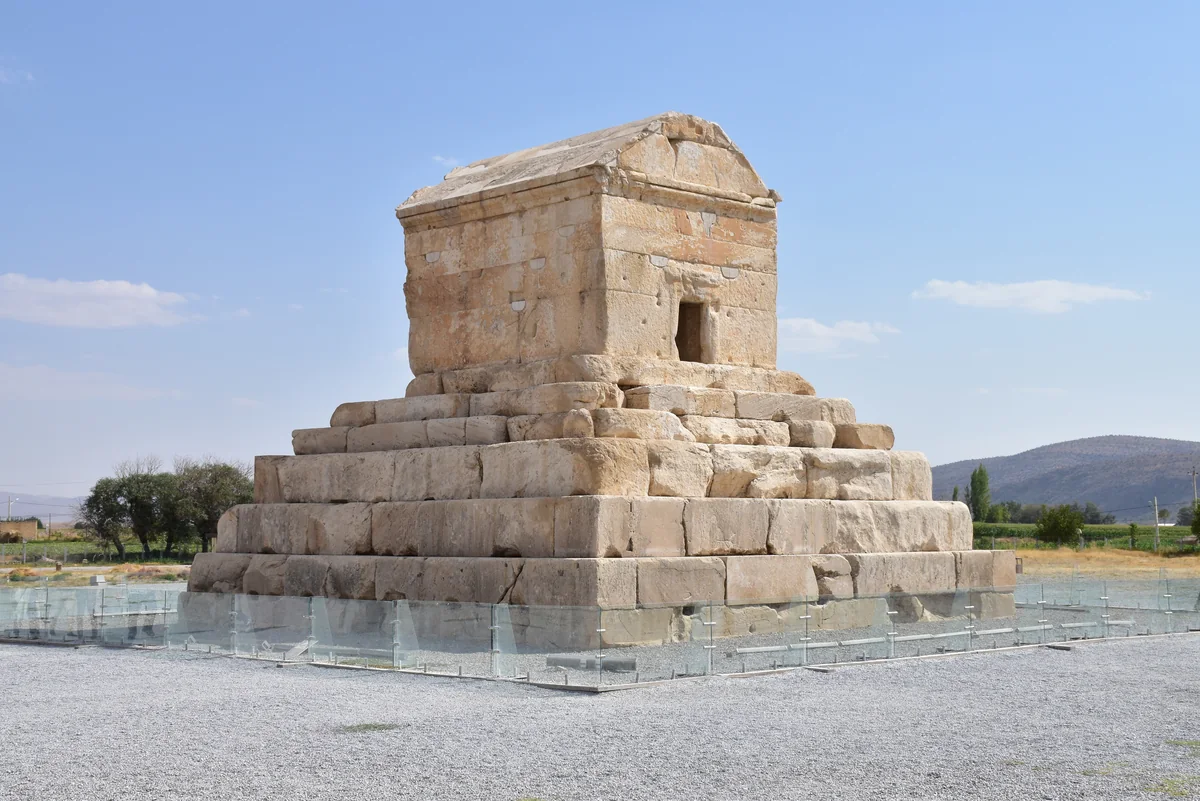
His dynastic capital at Pasargadae, in what is now Fars, is where later tradition places his tomb: a gabled stone house on a stepped platform, still standing. The photograph on this page shows that monument. It is not a portrait of the king. We have no contemporary likeness that can be tied to him with the same confidence as the inscriptions issued in his name.
Cyrus and Babylon
The event that produced the cylinder is the fall of Babylon in 539 BC. The Nabonidus Chronicle, a Babylonian cuneiform chronicle, describes the city’s capture; the cylinder describes the same change of power in the language of a building inscription, with the god Marduk choosing Cyrus and rejecting Nabonidus.[2][3] Those two sources agree that Cyrus took the city. They are not the same kind of text, and neither is a modern history.
After the conquest, the cylinder says, statues that Nabonidus had removed were returned to their temples, and Cyrus undertook work at Babylon, including the wall in whose foundations the barrel was buried.[3] That is the official Babylonian voice of the new regime, written in Akkadian, the language of the inscription.
Cyrus in the Hebrew Bible
Isaiah, Ezra and related biblical passages name Cyrus as the king who permitted the Jews to return from exile and to rebuild the Temple in Jerusalem. That tradition has a long afterlife in Jewish, Christian and later political writing.[4] It is a separate source from the cylinder.
The surviving text of the cylinder does not mention the Jews, Judah, Jerusalem or a temple there. The British Museum’s own description of the object does not introduce it in those terms.[3] Some readers still bring the two traditions together, because the cylinder does speak, in general terms, of returning people and cults to their places. That is a later comparison, and it is discussed in the Cyrus Cylinder and human rights, not treated here as a sentence the clay itself contains.
After Cyrus
Cyrus died around 530 BC, on campaign in the north-east of his empire according to the usual classical accounts; the details disagree, as they often do when later Greek writers are the source.[1][5] His son Cambyses succeeded him. The Achaemenid state he founded lasted until Alexander, and its palaces at Pasargadae, Persepolis and Susa are still the public face of the dynasty.
The cylinder is one small object from the first years of that empire, buried in a wall and found again in 1879. It tells us how Cyrus’s court wished Babylon to remember the conquest. For a copy you can put on a shelf, see our Cyrus Cylinder replica, a full-scale modern piece with the black display base included.
FAQ
When did Cyrus the Great take Babylon?
In 539 BC. That date is the usual one given for the fall of the Neo-Babylonian dynasty, and it is the date the British Museum uses for the cylinder.
Does the Cyrus Cylinder mention the Jews?
No. The surviving inscription does not mention the Jews or Judah. The biblical tradition about Cyrus is a different source.
Where is Cyrus buried?
Later tradition identifies the stone tomb at Pasargadae, in present-day Iran, as his. It is still standing.
Sources
- [1] Muhammad A. Dandamayev, “Cyrus iii. Cyrus II the Great,” Encyclopaedia Iranica, last updated 10 November 2011
- [2] A. K. Grayson, Assyrian and Babylonian Chronicles (Locust Valley: J. J. Augustin, 1975), Chronicle 7 (Nabonidus Chronicle); text also at Livius.org
- [3] British Museum, collection record: The Cyrus Cylinder, museum number 90920, registration 1880,0617.1941
- [4] Wikipedia, “Cyrus in the Hebrew Bible” or “Cyrus the Great in the Bible” (accessed Nov 2026)
- [5] Wikipedia, “Cyrus the Great” (accessed Nov 2026)
- [6] Muhammad A. Dandamayev, “Cyrus iv. The Cyrus cylinder,” Encyclopaedia Iranica, last updated 26 July 2013
- [7] Wikipedia, “Achaemenid Empire” (accessed Nov 2026)