 Ancient3DCrafts
The find
Hormuzd Rassam and the Cyrus Cylinder
Key points
- Hormuzd Rassam found the Cyrus Cylinder in March 1879 at Amran, in Babylon, while excavating for the British Museum.[2][1]
- The barrel came out in fragments and is still incomplete; a Yale fragment was joined in the 1970s.[2]
- The museum cites C. B. F. Walker’s 1972 study for the evidence of the findspot.[2]
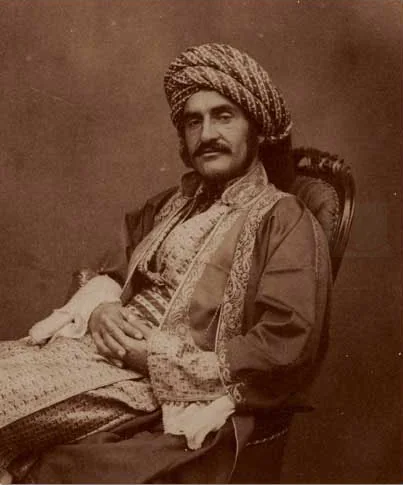
Who Hormuzd Rassam was
Hormuzd Rassam (1826–1910) was an archaeologist from Mosul, in present-day Iraq, who worked first with Austen Henry Layard and later led excavations for the British Museum in Assyria and Babylonia. He is the excavator named on the British Museum record for the Cyrus Cylinder.[1][2] The portrait on this page is a nineteenth-century photograph by Philip Henry Delamotte, in the public domain, shown at its original size rather than upscaled.
Rassam’s career was long, productive and, at times, contested in the London scholarly world of his day. This page stays with what can be said securely about the cylinder: he found it, the museum accessioned it, and later research has tried to pin down exactly where on the site it came from.
The find in March 1879
The British Museum record states that the cylinder was excavated by Rassam in March 1879 at Amran, Babylon, and that the museum relies on C. B. F. Walker’s 1972 discussion for the findspot evidence.[2] Amran (or Amran ibn Ali) is the area of the ruin field associated with the city’s sacred precinct. The object was a foundation deposit, so it was not found standing in a temple as a display piece; it had been buried in the wall. See foundation deposits in Babylon.
It was found in several fragments. Restoration in the nineteenth century, a conservation refiring in 1961, the joining of Yale’s fragment NBC 2504 in the 1970s, and the removal of 1970s plaster in 2007 all belong to the object’s modern life, not to 539 BC.[2] The cylinder remains incomplete. That is part of what you see in photographs of the original, and it is part of the shape followed by our replica.
From Babylon to London
The cylinder was registered at the museum in 1880 (registration 1880,0617.1941) and given the museum number 90920. Earlier numbers, BM.12049 and L1166, still appear in older literature.[2] Rawlinson published the text in the same year.[3] From 1879 the object has been more or less continually on display; how to look it up before a visit is in see the Cyrus Cylinder at the British Museum.
The first public life of the find was as an Assyriological publication, not as a political symbol. The later career of the cylinder as a modern emblem is a twentieth-century story, treated in the Cyrus Cylinder and human rights. For the object itself, start with the Cyrus Cylinder explained.
A word on credit, because Rassam’s name is sometimes dropped from popular retellings that jump straight from “Babylon” to “the British Museum.” The collection record names him as the excavator and dates the find to March 1879. Later writers have argued about the exact spot in the ruin field; the museum’s own pointer is Walker’s 1972 study, which is why this page does not invent a more precise findspot than Amran. The portrait we use is a period photograph, public domain, kept at its native size. It is a picture of the excavator, not evidence about the cylinder’s text.
FAQ
When was the Cyrus Cylinder found?
In March 1879, at Amran in Babylon, by Hormuzd Rassam, excavating for the British Museum.
Is the cylinder still in fragments?
It has been restored, and a Yale fragment was joined in the 1970s, but the object is still incomplete.
Where can I see a portrait of Rassam?
The photograph on this page is a public-domain portrait by Philip Henry Delamotte. Credit details are on our image licence page.
Sources
- [1] Wikipedia, “Hormuzd Rassam” (accessed Nov 2026)
- [2] British Museum, collection record: The Cyrus Cylinder, museum number 90920, registration 1880,0617.1941
- [3] H. C. Rawlinson, “Notes on a newly-discovered Clay Cylinder of Cyrus the Great,” Journal of the Royal Asiatic Society 12 (1880)
- [4] Muhammad A. Dandamayev, “Cyrus iv. The Cyrus cylinder,” Encyclopaedia Iranica, last updated 26 July 2013
- [5] Wikipedia, “Cyrus Cylinder” (accessed Nov 2026)