 Ancient3DCrafts
The text
What the Cyrus Cylinder inscription says
Key points
- The inscription is in Akkadian cuneiform, about 45 lines long; the first three lines are almost entirely lost and the end is still incomplete.[1][2]
- The British Museum summarises it as a Babylonian account of Cyrus’s conquest in 539 BC, of statues returned after Nabonidus, and of Cyrus’s work at Babylon.[2]
- The surviving text does not mention the Jews or Judah, and it is not a general charter of rights.[2]
Language and length
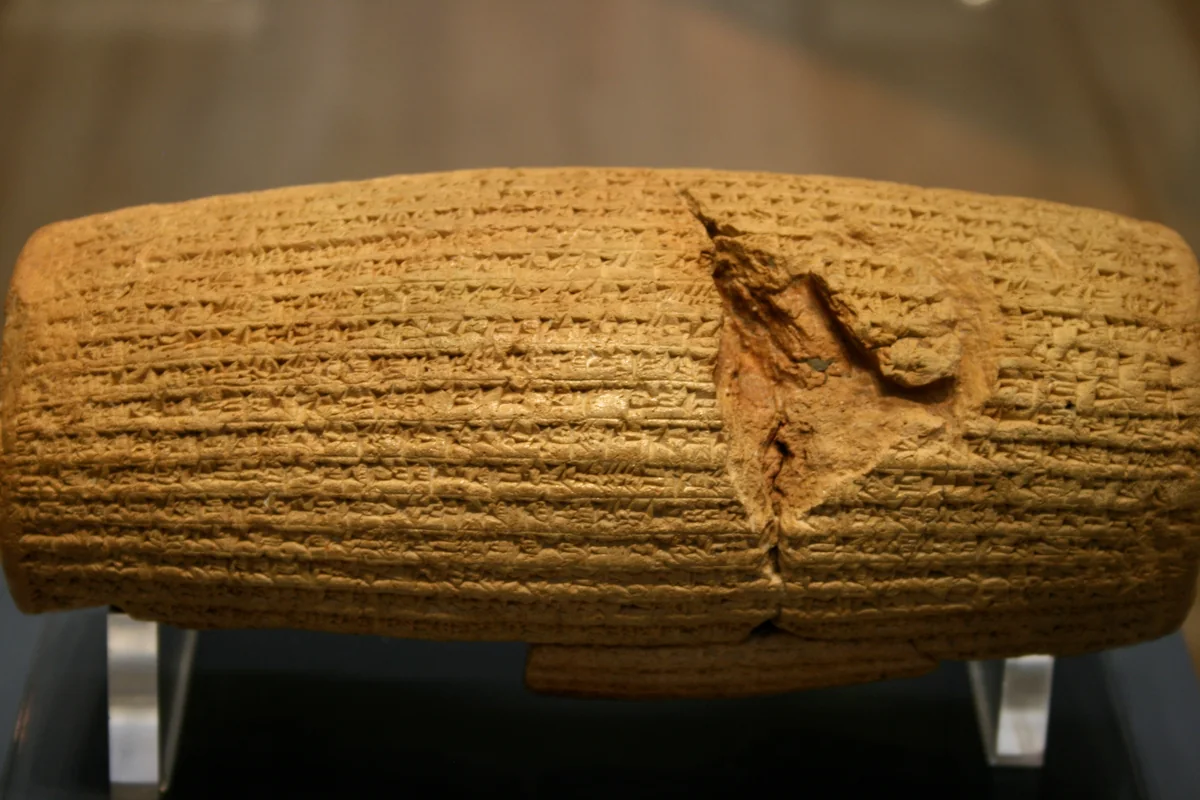
The Cyrus Cylinder is written in Akkadian, in the cuneiform script used for official Babylonian inscriptions in the sixth century BC. Encyclopaedia Iranica describes a text of some 45 lines. The first three are almost entirely broken away, and the end remains incomplete even after the Yale fragment was joined.[1][2] The signs were cut into a finer surface slip over a coarser clay core, then the barrel was fired.[2]
How the script works, and why a royal text was written in Akkadian rather than Old Persian, is set out in Akkadian cuneiform on the Cyrus Cylinder. This page stays with the content. We summarise the inscription from the British Museum’s description and from Iranica, in our own words, rather than pasting a long modern translation.
What the museum says it says
The British Museum’s collection record is deliberately plain. The text is “a Babylonian account of the conquest of Babylon by Cyrus in 539 BC, of his restoration to various temples of statues removed by Nabonidus, the previous king of Babylon, and of his own work at Babylon.” It adds that the text is incomplete.[2]
Iranica and the standard handbook discussions fill in the shape of the surviving lines: the god Marduk is displeased with Nabonidus; he searches for a righteous king and chooses Cyrus; Cyrus enters Babylon without the destruction the text attributes to the previous regime; cult statues are sent home; people who had been settled elsewhere are returned; Cyrus claims work on the city’s walls, in whose foundations this barrel was meant to lie.[1][3] Those themes belong to a long Mesopotamian tradition of royal building inscriptions, which is why foundation deposits matter for reading it.
What the text does not say
Two popular claims need to be kept apart from the clay. First, the surviving inscription does not mention the Jews, Judah or Jerusalem. The British Museum record does not describe the object in those terms.[2] The biblical portrait of Cyrus is real as a biblical tradition; it is not a quotation from this barrel. See who was Cyrus the Great? for that distinction.
Second, the cylinder is not, in its own words, a “charter of human rights.” It is a royal inscription about conquest, cult and building. The later political life of that phrase, including the 1971 replica presented in a United Nations setting, is a history of reception, treated in the Cyrus Cylinder and human rights.
How to read it carefully
The first publication of the text was by Henry Rawlinson in 1880, in the Journal of the Royal Asiatic Society.[4] Editions and translations have been improved as fragments were joined and as Assyriology itself advanced. A convenient overview of the text, with a translation after the standard editions, is maintained by Jona Lendering at Livius.org; it is a starting point, not a substitute for a critical edition.[3][5]
The object that carries the signs is described in the Cyrus Cylinder explained. Our replica follows the barrel’s present shape, including the broken hollow, so that the inscription’s surface can be seen as an object, not only as a printed text.
FAQ
What language is the Cyrus Cylinder written in?
Akkadian, in cuneiform script. It is a Babylonian royal inscription, not an Old Persian text.
How long is the inscription?
About 45 lines, according to Encyclopaedia Iranica. The first three lines are almost entirely lost, and the end is still incomplete.
Does the inscription mention human rights or the Jews?
No. The surviving text is a foundation inscription about conquest, returned statues and building work. It does not mention the Jews or Judah.
Sources
- [1] Muhammad A. Dandamayev, “Cyrus iv. The Cyrus cylinder,” Encyclopaedia Iranica, last updated 26 July 2013
- [2] British Museum, collection record: The Cyrus Cylinder, museum number 90920, registration 1880,0617.1941
- [3] Livius.org, Jona Lendering, “Cyrus Cylinder”
- [4] H. C. Rawlinson, “Notes on a newly-discovered Clay Cylinder of Cyrus the Great,” Journal of the Royal Asiatic Society 12 (1880)
- [5] Livius.org, Jona Lendering, “Cyrus Cylinder (2): the text of the cylinder” (translation after the standard editions)
- [6] Wikipedia, “Cyrus Cylinder” (accessed Nov 2026)