 Ancient3DCrafts
The practice
Foundation deposits in Babylon
Key points
- The British Museum says the cylinder was written to be buried in the foundations of the city wall of Babylon after Cyrus took the city in 539 BC.[2]
- Barrel-shaped clay cylinders are a typical form for Late Babylonian royal inscriptions.[2][1]
- The text’s claims about building and restoration belong to that buried, official genre, not to a public monument.[2][3]
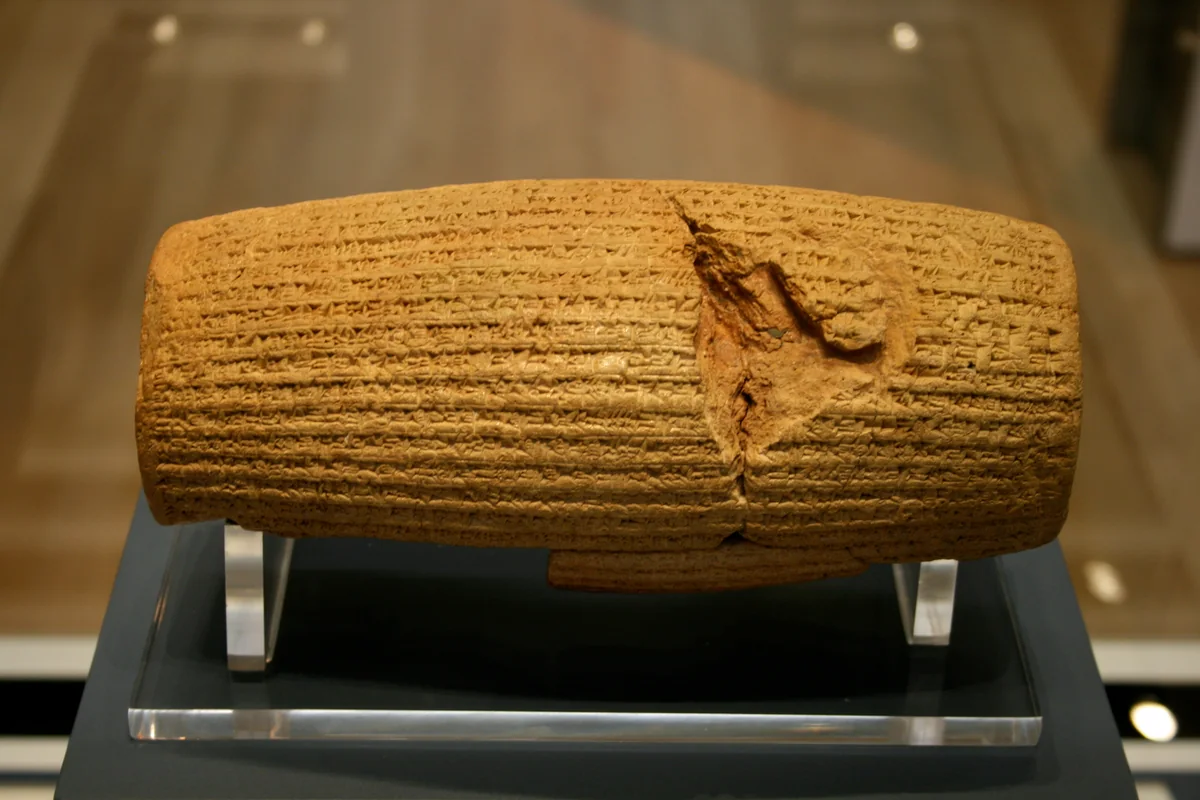
What a foundation deposit is
A foundation deposit is an object placed in the foundations of a building when it is constructed or restored: a figurine, a inscribed tablet, a cylinder, sometimes a box of offerings. In Mesopotamia the practice is old. Kings used it to record their work for the gods and for later rulers who might dig the building up. The deposit was not, in the first instance, a public inscription for passers-by to read.[1]
The Cyrus Cylinder belongs to that habit. The British Museum notes that the cylindrical form is typical of Late Babylonian royal inscriptions, and that the text shows the object was written to be buried in the foundations of the city wall of Babylon, deposited there after Cyrus captured the city in 539 BC, presumably on his orders.[2] The political setting is the fall of Babylon; the wording is treated in the inscription.
A barrel in a wall
Because the cylinder was a buried text, the way it came back to light is an excavation story, not a story of a statue taken off a plinth. Hormuzd Rassam found it in March 1879 at Amran, in fragments.[2] That find, and the later joins, are described in Rassam and the Cyrus Cylinder. A foundation deposit that has been in the ground for more than two millennia is likely to be broken. The incomplete state of 90920 is not surprising; it is what the genre predicts.
The text itself talks about work at Babylon and about the wall. That is not an afterthought. A king who claims to restore a city has a reason to leave his name in the brickwork. Later readers, seeing the object in a glass case, sometimes treat it as if it had always been a display piece. It was made to disappear into a foundation. The Cyrus Cylinder explained starts from that fact.
Why genre matters
Once you know the object is a foundation inscription, some modern claims become easier to place. A charter displayed to a population, or a law code set up in a courtyard, would be a different kind of text in a different kind of place. The cylinder’s language of divine choice, returned statues and building work is the language such buried inscriptions use.[3][2] That does not make the content trivial. It does mean the object should be compared with other royal building texts before it is compared with much later ideas of a bill of rights.
Our replica is, of course, a display object. It sits on a black base in a room, which is the opposite of a wall foundation. That is the point of a modern copy: it lets you look at a shape that was designed not to be looked at. It does not change what the original was for.
FAQ
Why was the Cyrus Cylinder buried?
It is a foundation inscription. The British Museum says it was written to be buried in the foundations of the city wall of Babylon after the conquest of 539 BC.
Were clay cylinders a common form?
The museum notes that the cylindrical form is typical of Late Babylonian royal inscriptions.
Was the cylinder meant to be read in public?
It was made as a deposit in a wall, not as a public monument. Its modern display life in the British Museum is a separate, later chapter.
Sources
- [1] Wikipedia, “Foundation deposit” (accessed Nov 2026)
- [2] British Museum, collection record: The Cyrus Cylinder, museum number 90920, registration 1880,0617.1941
- [3] Muhammad A. Dandamayev, “Cyrus iv. The Cyrus cylinder,” Encyclopaedia Iranica, last updated 26 July 2013
- [4] Wikipedia, “Cyrus Cylinder” (accessed Nov 2026)