 Ancient3DCrafts
The conquest
The fall of Babylon in 539 BC
Key points
- In 539 BC Cyrus took Babylon and ended the Neo-Babylonian dynasty of Nabonidus.[2][5]
- The Nabonidus Chronicle describes the city’s capture; the Cyrus Cylinder describes the same change of power as a royal building inscription.[2][1]
- Both sources should be read as ancient texts with their own purposes, not as a modern news report of the siege.[2][4]
The year 539 BC
539 BC is the year in which Cyrus the Great took Babylon and the Neo-Babylonian kingdom came to an end. Nabonidus was the last king of that dynasty. The date is the one the British Museum uses when it places the Cyrus Cylinder “after 539 BC,” written in Babylon once the city was in Persian hands.[1] The man who took the city is introduced in who was Cyrus the Great?.
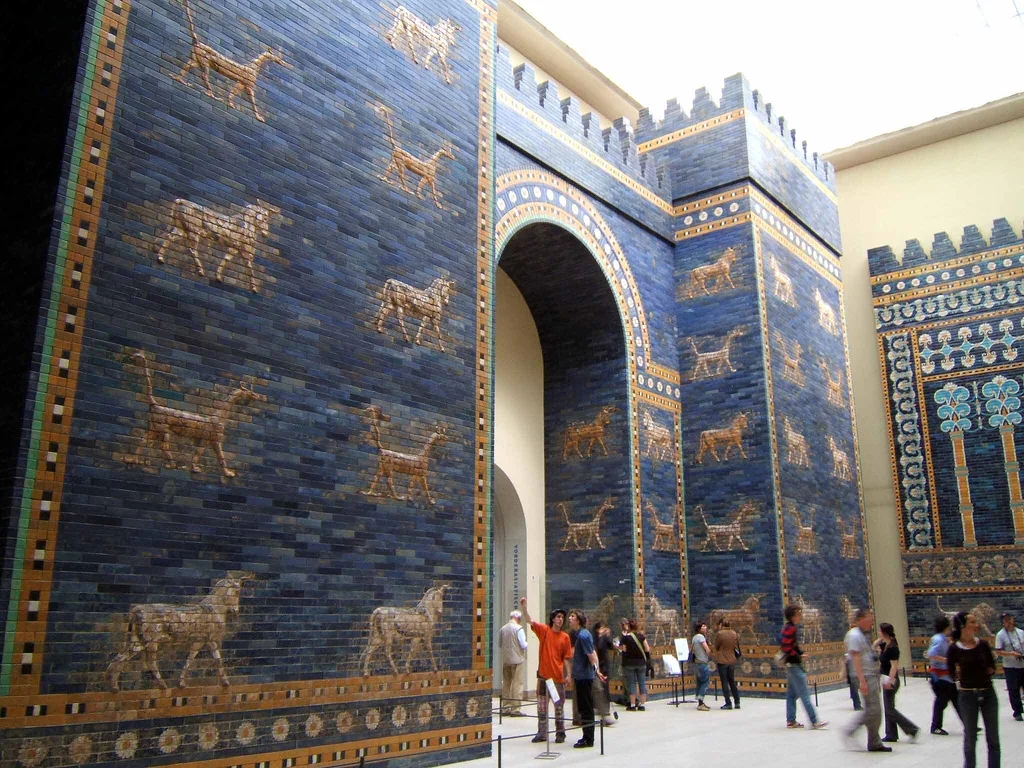
The photograph on this page is a reconstruction of the Ishtar Gate, now in the Pergamon Museum in Berlin. The gate itself was built earlier, under Nebuchadnezzar II. It is here as a reminder of the city Cyrus entered, not as a monument he built. Credits for the photograph are on the image licence page.
The Nabonidus Chronicle
The main cuneiform narrative of the campaign is the Nabonidus Chronicle (often cited as ABC 7, in A. K. Grayson’s edition of the Babylonian chronicles). In the usual reading of the surviving lines, a Persian force under Ugbaru (Gubaru) entered Babylon, and Cyrus himself entered the city shortly afterwards. The chronicle does not describe a long, destructive sack of the capital.[2][3]
Chronicles of this kind are terse, dated, and themselves the product of Babylonian scribal tradition. They are invaluable, and they are not complete for every year. Gaps and damage in the tablet have to be respected. Livius.org hosts a convenient English presentation of Grayson’s text; the edition remains the scholarly reference.[2]
What the cylinder adds
The Cyrus Cylinder inscription is not a chronicle. It is a foundation text buried in the city wall, and it tells the conquest as a story of divine choice. Marduk is angry with Nabonidus, selects Cyrus, and the new king enters and restores what the previous king is said to have disturbed.[1][4] That is how a victorious court wanted the walls of Babylon to speak.
Read side by side, the chronicle and the cylinder agree on the fact of the takeover and differ in genre and emphasis. The cylinder’s language of welcome and restoration is official ideology. It should not be flattened into a simple claim that “the city was glad,” any more than it should be dismissed as invented. The cylinder explained and foundation deposits in Babylon set the object in that building context.
After the capture
Persian rule in Babylon did not empty the city. Babylon remained a great urban and cult centre, and Achaemenid kings continued to use Babylonian administrative habits. The cylinder’s concern with returned statues and with the wall is part of that settlement: a new king speaking, in Akkadian, as a patron of Babylonian temples.[4][5]
Later tradition, including the Hebrew Bible, remembers 539 BC as a turning point for the Judaean exiles. That memory is historically important. It is not written on the cylinder, which does not name Judah. The two records can be studied together without being treated as one text.
FAQ
When did Babylon fall to Cyrus?
In 539 BC, according to the standard chronology used by the British Museum and in handbook accounts of the period.
Did Cyrus destroy Babylon?
The Nabonidus Chronicle does not describe a destructive sack of the capital. The Cyrus Cylinder presents the entry as a restoration. Both are ancient sources, not modern battle reports.
Is the Cyrus Cylinder a chronicle of the battle?
No. It is a foundation inscription. The main chronicle source for the capture is the Nabonidus Chronicle.
Sources
- [1] British Museum, collection record: The Cyrus Cylinder, museum number 90920, registration 1880,0617.1941
- [2] A. K. Grayson, Assyrian and Babylonian Chronicles (Locust Valley: J. J. Augustin, 1975), Chronicle 7 (Nabonidus Chronicle); text also at Livius.org
- [3] Wikipedia, “Nabonidus Chronicle” (accessed Nov 2026)
- [4] Muhammad A. Dandamayev, “Cyrus iv. The Cyrus cylinder,” Encyclopaedia Iranica, last updated 26 July 2013
- [5] Wikipedia, “Fall of Babylon” (accessed Nov 2026)
- [6] Livius.org, Jona Lendering, “Cyrus Cylinder”