 Ancient3DCrafts
The object · Hub
The Cyrus Cylinder explained
Key points
- A fired-clay, wheel-made barrel cylinder inscribed in Akkadian cuneiform in the name of Cyrus the Great, after he took Babylon in 539 BC.[1]
- British Museum number 90920, registration 1880,0617.1941; found by Hormuzd Rassam at Amran, Babylon, in March 1879.[1]
- Written to be buried in the foundations of the city wall of Babylon. The text is incomplete; a Yale fragment was joined in the 1970s.[1][2]
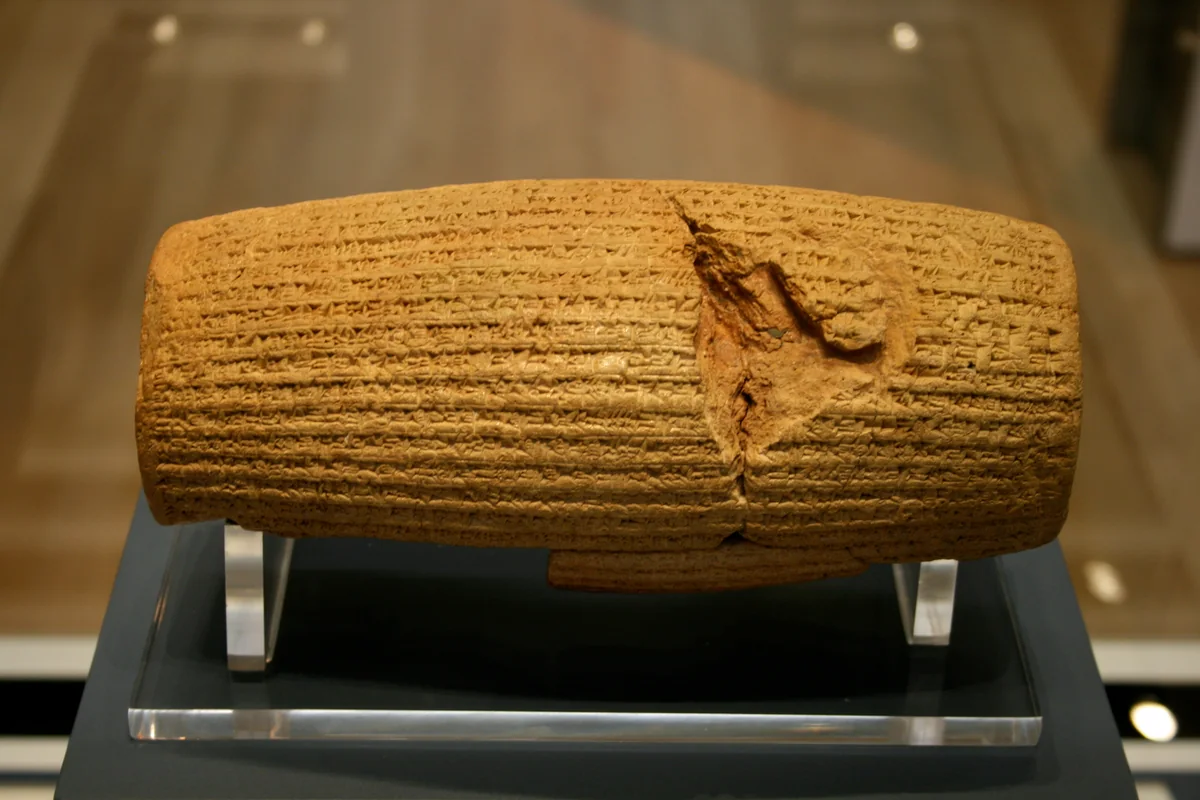
The object label
| Object | Fired-clay, wheel-made barrel cylinder; Akkadian cuneiform royal inscription[1] |
|---|---|
| Authority | Issued in the name of Cyrus the Great; Achaemenid period[1] |
| Date and place | After 539 BC, made in Babylon[1] |
| Findspot | Amran, Babylon; excavated by Hormuzd Rassam, March 1879[1] |
| Purpose | A foundation inscription, buried in the city wall of Babylon[1] |
| Museum number | 90920 (registration 1880,0617.1941; earlier also BM.12049 and L1166)[1] |
| Size | Length 21.90–22.80 cm; maximum diameter 10 cm[1] |
| Condition | Found in fragments; still incomplete after restoration[1] |
This page is the hub for the original object. For a line-by-line sense of the wording, see what the inscription says. For the man in whose name it was written, see who was Cyrus the Great?. Our full-scale replica is described, with measurements, in size and materials.
What it is
The Cyrus Cylinder is not a law code, a treaty, or a monument meant to be read in a public square. It is a foundation deposit: a clay barrel, made on a wheel, inscribed, fired, and buried in the foundations of Babylon’s city wall after Cyrus captured the city in 539 BC. The British Museum describes the text as a Babylonian account of that conquest, of the return to various temples of statues that Nabonidus, the previous king, had removed, and of Cyrus’s own work at Babylon. The text is incomplete.[1]
Encyclopaedia Iranica counts about 45 lines of Akkadian. The first three are almost entirely lost, and the end is still incomplete even after a fragment from the Yale Babylonian Collection was joined in the 1970s.[2][1] That is why careful writing about the cylinder stays close to what survives, and why later slogans about the object need a separate discussion, in the Cyrus Cylinder and human rights.
Where and when it was found
Hormuzd Rassam found the cylinder in March 1879 at Amran, in Babylon, during excavations for the British Museum. The museum cites C. B. F. Walker’s 1972 study for the findspot evidence. It came out in several fragments and has been restored more than once; it is still not complete.[1] The story of that excavation is in Hormuzd Rassam and the Cyrus Cylinder.
A further fragment, NBC 2504 in the Yale Babylonian Collection, restoring part of lines 36–45, was joined to the London pieces in the 1970s (the loan was agreed in January 1972). Plaster filling added in that period was removed in 2007. The object had already been refired in 1961 for conservation. The museum notes a coarse clay core with large grey stone inclusions, and a finer surface slip added before the inscription was written, after which the cylinder was fired.[1]
What the text is for
Late Babylonian royal inscriptions often took this barrel form, and the museum says the text shows the cylinder was written to be buried in the wall foundations, deposited there after the capture of the city, presumably on Cyrus’s orders.[1] That practice — hiding a royal text in a building so that later kings, or the gods, would find it — is older than the Achaemenids. See foundation deposits in Babylon.
The political setting is the fall of Babylon in 539 BC. The cylinder presents that event in the language of a Babylonian building inscription: Marduk is angry with Nabonidus, chooses Cyrus, and Cyrus enters the city and restores cults. That is royal ideology, written in Akkadian, not a neutral chronicle and not a Hebrew text. The inscription does not mention the Jews or Judah. How the biblical Cyrus relates to this object is discussed with the popular “charter” claim, not treated here as a fact about the clay.
The cylinder today
The original has been more or less continually on display at the British Museum in London since 1879.[1] Current gallery information changes, so the reliable starting point is the museum’s collection record for 90920; practical notes are in how to see the Cyrus Cylinder. Photographs of the original on this site are freely licensed visitor photographs, credited under each image and listed on the image licence page. This site is not affiliated with the museum.
If you want a full-scale copy to handle or display, our Cyrus Cylinder replica is taken from a 3D scan of the British Museum original. It is 9 inches long and 3.75 inches in diameter excluding the base, the finished weight is 600 g, and the black display base is included. It is a modern object, hand-finished in Ontario, not an antiquity. A short buying guide sets out price, ordering and what arrives in the box.
FAQ
What is the museum number of the Cyrus Cylinder?
British Museum number 90920; registration number 1880,0617.1941. It was earlier also numbered BM.12049 and L1166.
Who found the Cyrus Cylinder?
Hormuzd Rassam, in March 1879, at Amran in Babylon, during excavations for the British Museum.
Is the Cyrus Cylinder complete?
No. It was found in fragments and is still incomplete after restoration. A Yale fragment, NBC 2504, was joined in the 1970s.
Sources
- [1] British Museum, collection record: The Cyrus Cylinder, museum number 90920, registration 1880,0617.1941
- [2] Muhammad A. Dandamayev, “Cyrus iv. The Cyrus cylinder,” Encyclopaedia Iranica, last updated 26 July 2013
- [3] Livius.org, Jona Lendering, “Cyrus Cylinder”
- [4] Wikipedia, “Cyrus Cylinder” (accessed Nov 2026)
- [5] Ancient3DCrafts, Etsy listing “Cyrus Cylinder Replica Museum Style” (listing 1816866470)
- [6] Ancient3DCrafts, product facts for the Cyrus Cylinder replica (size, weight, included base), as confirmed by the maker, November 2026