 Ancient3DCrafts
The script
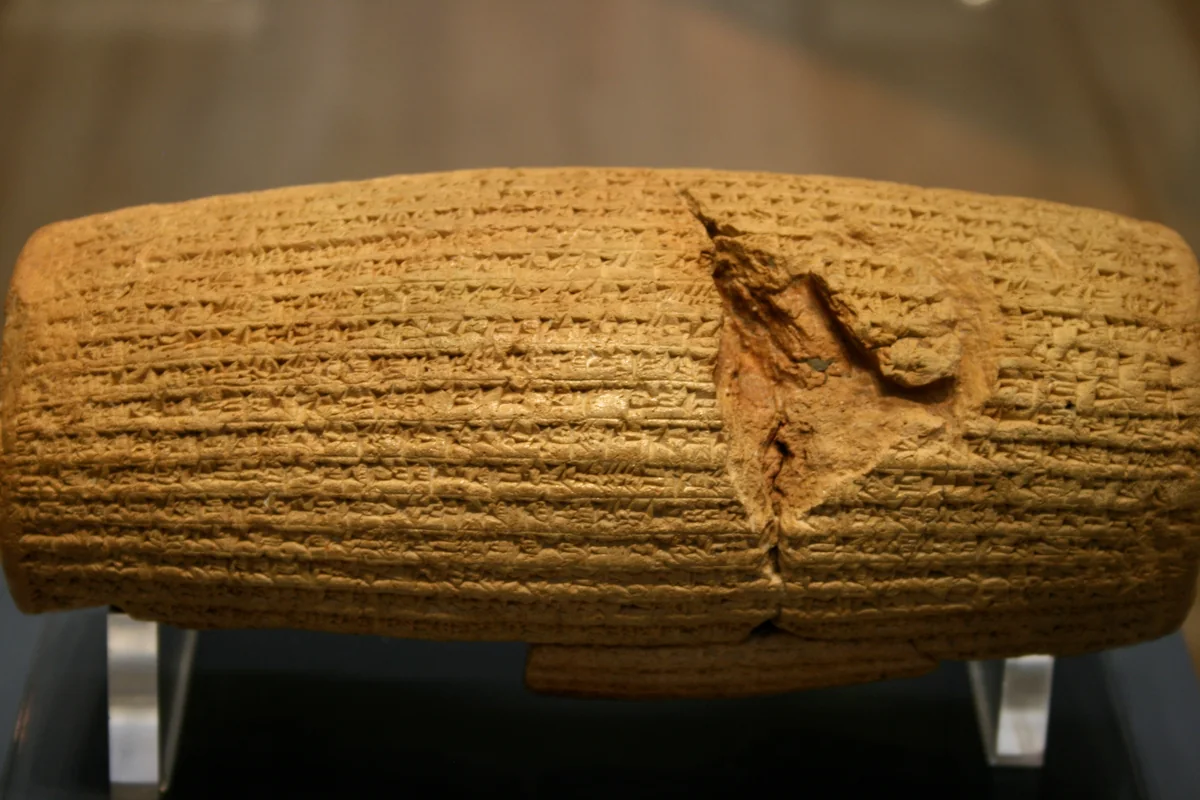
Akkadian cuneiform on the Cyrus Cylinder
Key points
- The Cyrus Cylinder is written in Akkadian, in cuneiform, as a Late Babylonian royal inscription, not in Old Persian.[1][2][3]
- Encyclopaedia Iranica describes a text of about 45 lines; the first three are almost lost and the end is still incomplete.[2]
- The signs were cut into a fine surface slip over a coarser clay core, then the barrel was fired.[1]
Why Akkadian, not Old Persian
Cyrus was a Persian king, but the cylinder buried in the wall of Babylon speaks Babylonian. The language is Akkadian, written in the cuneiform script that scribes in the city had used for official inscriptions for centuries. That choice is part of the object’s meaning. The new regime addressed Babylon’s gods and walls in the traditional language of Babylonian kingship.[1][2][3]
Old Persian cuneiform, the script of later Achaemenid cliff inscriptions, is a different writing system and is not what you see on this barrel. If you are looking at a photograph and trying to “spot Persian letters,” you will not find them. What you will find is a tightly packed Late Babylonian hand, running in horizontal lines around a curved surface. The content of those lines is summarised in what the inscription says.
How the signs were written
The British Museum’s conservation notes describe a coarse clay core with large grey stone inclusions, and a finer slip on the surface. The inscription was written on that slip, and the cylinder was then fired.[1] In other words, the text is not a later engraving on a finished ceramic. It is part of how the object was made, which is what one would expect of a foundation deposit prepared to be buried.
Iranica’s figure of about 45 lines is the usual one cited in handbook discussions. Damage is severe at the beginning: the first three lines are almost entirely gone. The end was also incomplete until a Yale fragment, NBC 2504, restored part of lines 36–45 in the 1970s, and even now the text is not whole.[2][1] Any translation that reads as a smooth, unbroken proclamation is filling gaps, and should say so.
Reading it today
Cuneiform on a barrel is harder to photograph than cuneiform on a flat tablet. Light rakes across a curve, signs disappear into breaks, and plaster or fills from old restorations can confuse the eye. That is one reason published editions, not a single tourist photograph, remain the way into the text. Rawlinson’s 1880 notice was the first publication; later editions have used the joined fragments and a better knowledge of Late Babylonian.[4][5]
You do not need to read Akkadian to understand what kind of object this is. The script tells you it is a Babylonian royal inscription; the shape tells you it was meant to be buried; the museum record tells you what the surviving text is about. Those points are gathered in the Cyrus Cylinder explained. Our replica copies the inscribed surface as it survives, so the pattern of signs can be seen in the round, as an object, even when the language stays with the specialists.
We do not print a full modern translation on this site. Long translations are the work of their editors, and a website summary is not a critical edition. Short, clearly credited overviews — the museum’s own prose, Iranica’s description, and a handbook translation used as a guide — are enough for a general reader. If you want to learn the signs themselves, a grammar of Akkadian and a sign list are the proper next step, not a product page. The replica will still be useful as a three-dimensional reminder of how tightly those signs were fitted onto a small, curved barrel.
FAQ
What script is on the Cyrus Cylinder?
Cuneiform, writing the Akkadian language. It is a Late Babylonian royal inscription, not an Old Persian text.
How many lines are there?
About 45, according to Encyclopaedia Iranica. The first three lines are almost entirely lost, and the end is still incomplete.
Was the text carved after the clay was fired?
No. The museum describes signs written on a fine surface slip, after which the cylinder was fired.
Sources
- [1] British Museum, collection record: The Cyrus Cylinder, museum number 90920, registration 1880,0617.1941
- [2] Muhammad A. Dandamayev, “Cyrus iv. The Cyrus cylinder,” Encyclopaedia Iranica, last updated 26 July 2013
- [3] Wikipedia, “Cuneiform” (accessed Nov 2026)
- [4] H. C. Rawlinson, “Notes on a newly-discovered Clay Cylinder of Cyrus the Great,” Journal of the Royal Asiatic Society 12 (1880)
- [5] Livius.org, Jona Lendering, “Cyrus Cylinder (2): the text of the cylinder” (translation after the standard editions)